¶ 03 SVP Video Processing
SVP (Smart Video Processing) is the core module for intelligent video processing. It gives developers a complete API set covering person, face, vehicle, fire/smoke, and DMS (driver monitoring) analytics.
This document uses YOLOv5 person detection as the example and walks through the whole intelligent vision pipeline, from model loading to inference output.
¶ 1 Architecture Overview
The GK7206 integrates a dedicated NPU (neural processing unit) that runs convolutional network inference efficiently. The data flow is:
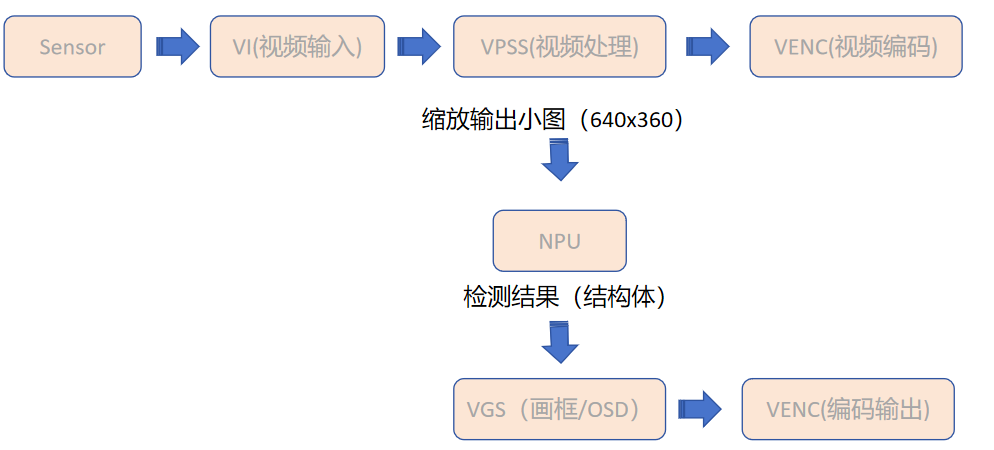
Key hardware modules:
| Module | Full name | Function |
|---|---|---|
| VI | Video Input | Receives raw images captured by the sensor |
| VPSS | Video Processing Sub-System | Scales and crops images, outputting several resolutions |
| NPU | Neural Processing Unit | Neural network inference (convolution, pooling, activation, etc.) |
| VGS | Video Graphics Sub-System | Overlays rectangles, text, and other OSD elements on the image |
| VENC | Video Encoder | H.264 / H.265 video encoding |
| MMZ | Media Memory Zone | Physically contiguous memory management for media |
¶ 2 SVP Video Development Pipeline
Before the camera image reaches the NPU it passes through a chain of hardware modules:
Sensor -> VI -> VPSS -> channel0: full frame (1920x1080) -> VENC (main stream) / VO (display)
                                 -> channel1: small frame (640x360)   -> NPU inference
                                 -> channel2: medium frame (1280x720)   -> VENC (sub stream) / NPU (full-frame model)
Why scaling is needed
- NPU models are trained at a fixed resolution (for example 640x360)
- VPSS hardware performs the scaling automatically, with no CPU involvement
- The scaled frame is handed to the NPU directly in physical memory, which is zero-copy
Where the code lives: sample_svp_main.c:1108-1161
¶ 3 The Complete SVP Pipeline
¶ 3.1 Initializing the SVP Subsystem
SVP (Smart Vision Platform) is the GK7206 intelligent vision platform interface. It must be initialized before the NPU is used:
// file: sample_svp_main.c -> sample_svp_start()

xmedia_s32 ret;

// step 1: initialize the SVP subsystem
ret = xmedia_svp_init();
if (ret != XMEDIA_SUCCESS) {
    printf("xmedia_svp_init error.\n");
    return XMEDIA_FAILURE;
}
Important:
xmedia_svp_init()only needs to be called once for the whole application lifetime.
¶ 3.2 Loading the Model and Allocating Memory
The NPU needs dedicated physically contiguous memory for model weights and intermediate results.
¶ 3.2.1 Configuring Model Information
For person detection, the model parameters are configured as follows:
xmedia_svp_modules modules[8];  // up to 8 models
xmedia_svp_task_cfg task_cfg;

// configure model 0: person detection
modules[0].alg_type  = XMEDIA_SVP_ALG_TYPE_PERSON;           // algorithm type
modules[0].load_mode = XMEDIA_SVP_MODEL_FILE;                 // load from file
modules[0].format    = XMEDIA_SVP_INPUTDATA_FORMAT_RGB888;    // input format
modules[0].pathname  = "./model/gnn_person_detect_640x360_rgb888hwc_v0103_20251203.bin";

task_cfg.module_num = 1;                     // this task uses 1 model
task_cfg.task_type  = XMEDIA_SVP_TASK_DETECT; // detection task
task_cfg.modules    = modules;
Model configuration fields:
| Field | Description | Valid values |
|---|---|---|
alg_type |
Algorithm category | XMEDIA_SVP_ALG_TYPE_PERSON, XMEDIA_SVP_ALG_TYPE_FACE, XMEDIA_SVP_ALG_TYPE_CAR, etc. |
load_mode |
Load method | XMEDIA_SVP_MODEL_FILE (from file), XMEDIA_SVP_MODEL_MEM (from memory) |
format |
Input image format | XMEDIA_SVP_INPUTDATA_FORMAT_RGB888, XMEDIA_SVP_INPUTDATA_FORMAT_YUV420SP |
pathname |
Model file path | NPU-specific model file in .bin format |
¶ 3.2.2 Querying Model Memory Requirements
// query the memory the model needs
xmedia_cl_mem_info model_mem_info;
ret = xmedia_cl_graph_query_model_info_from_file(
    modules[0].pathname,
    &model_mem_info,
    XMEDIA_CL_MEM_INFO
);

// model_mem_info contains:
//   worksize  - NPU working buffer size (intermediate results)
//   inputsize - input buffer size (holds the input image)
//   outputsize- output buffer size (raw inference results)
¶ 3.2.3 Allocating NPU Memory
xmedia_svp_cfg svp_cfg;
xmedia_svp_get_config(&svp_cfg);

svp_cfg.reuse_type = XMEDIA_SVP_MEM_TYPE_BLOCK;  // block reuse mode

// allocate the working buffer (used internally by the NPU; needs cache attributes)
sample_mmz_alloc_and_map_cache(
    XMEDIA_NULL, "npu_work_mem",
    &svp_cfg.workbuf_reuse_mem.phyaddr,   // physical address
    &svp_cfg.workbuf_reuse_mem.viraddr,   // virtual address
    svp_cfg.workbuf_reuse_mem.size         // size
);

// allocate the input buffer (holds the input image data)
sample_mmz_alloc_and_map(
    XMEDIA_NULL, "npu_input_mem",
    &svp_cfg.input_reuse_mem.phyaddr,
    &svp_cfg.input_reuse_mem.viraddr,
    svp_cfg.input_reuse_mem.size
);

// allocate the output buffer (holds the raw inference results)
sample_mmz_alloc_and_map_cache(
    XMEDIA_NULL, "npu_output_mem",
    &svp_cfg.output_reuse_mem.phyaddr,
    &svp_cfg.output_reuse_mem.viraddr,
    svp_cfg.output_reuse_mem.size
);

// hand the memory configuration to SVP
xmedia_svp_set_config(&svp_cfg);
¶ 3.3 Creating an Inference Task
With the model configured and memory ready, create the SVP task (this is when the model is actually loaded into the NPU):
xmedia_s32 svp_handle;
ret = xmedia_svp_task_create(&svp_handle, task_cfg);
if (ret != XMEDIA_SUCCESS) {
    printf("xmedia_svp_task_create failed!\n");
    return XMEDIA_FAILURE;
}
// svp_handle is the handle for all later inference calls
Key concept: one
svp_handlerepresents one complete inference pipeline, including the loaded model, pre/post-processing, and all related resources.
¶ 3.4 Setting Inference Parameters
After creating the task you can adjust inference parameters (thresholds, tracking, and so on):
// YOLOv5 detection attributes
xmedia_svp_yolov5_attr yolov5_attr;

yolov5_attr.detect_threshold     = 0.65f;   // detection confidence threshold (lower scores are dropped)
yolov5_attr.classifier_threshold = 0.8f;    // classifier confidence threshold
yolov5_attr.iou_threshold        = 0.5f;    // NMS IoU threshold (filters overlapping boxes)
yolov5_attr.max_target_num       = 10;      // max targets per frame (50 at most)
yolov5_attr.bytetrack_enable     = XMEDIA_TRUE;  // enable ByteTrack object tracking
yolov5_attr.motionless_filter_enable = XMEDIA_TRUE; // enable motion-state detection
yolov5_attr.stillness_thres      = 0.9f;    // stillness detection sensitivity
yolov5_attr.movement_fps_thres   = 5;       // consecutive-frame threshold
yolov5_attr.smart_venc_enable    = XMEDIA_FALSE; // smart encoding
yolov5_attr.smart_ae_enable      = XMEDIA_FALSE; // smart exposure

ret = xmedia_svp_task_set_attr(svp_handle, &yolov5_attr);
Tuning suggestions:
| Parameter | Suggested value | Effect of raising | Effect of lowering |
|---|---|---|---|
detect_threshold |
0.65 | Fewer false positives, more misses | Fewer misses, more false positives |
iou_threshold |
0.5 | Keeps more overlapping boxes | Merges more overlapping boxes |
max_target_num |
10 | Handles more targets, slightly slower | Caps target count, more stable |
bytetrack_enable |
TRUE | Cross-frame tracking with tracker_id | Per-frame detection only, no tracking |
¶ 3.5 Starting the Inference Thread
Once initialization is done, start a dedicated thread to run the inference loop:
// sample_svp_info holds all runtime state
sample_svp_info svp_info;
svp_info.detect_type = SAMPLE_SVP_ALG_TYPE_PERSON;
svp_info.svp_handle  = svp_handle;
svp_info.vpss_pipe   = vpss_pipe;
svp_info.vpss_ochn[1] = small_channel;  // small-frame channel
svp_info.venc_chn[1]  = venc_channel;    // encoder channel
svp_info.big_stream   = XMEDIA_FALSE;

g_svp_start_flag = XMEDIA_TRUE;

// create the inference thread
pthread_create(&g_svp_thread, NULL, sample_svp_proc, &svp_info);
¶ 4 Frame Acquisition and the Inference Loop
sample_svp_proc() is the main inference loop thread. It keeps taking frames from VPSS, submitting them to the NPU, and handling the results.
¶ 4.1 Acquiring a Camera Frame
// sample_svp_main.c → sample_svp_proc()

while (g_svp_start_flag == XMEDIA_TRUE) {
    xmedia_video_frame_info video_frame;
    xmedia_s32 milli_sec = 20000;  // 20 second timeout

    // acquire one small frame from VPSS (640x360)
    ret = xmedia_vpss_acquire_ochn_frame(
        svp_info->vpss_pipe,       // VPSS pipe
        svp_info->vpss_ochn[1],    // output channel 1 (small frame)
        &video_frame,              // output frame info
        milli_sec                  // timeout
    );
    if (ret != XMEDIA_SUCCESS) {
        printf("get vpss small frame failed!\n");
        continue;  // frame acquisition failed, retry
    }
Key information in video_frame:
video_frame (xmedia_video_frame_info)
  ├── frame.width            = 640
  ├── frame.height           = 360
     +-- frame.addr.y_phy_addr  -> physical address of the Y plane
     +-- frame.addr.uv_phy_addr -> physical address of the UV plane
  ├── frame.pixel_format     = YUV420SP
     +-- pool_id                -> VB pool ID
Important: the frame data lives in physical memory and needs no copy. The NPU accesses it through its physical address.
¶ 4.2 Submitting to the NPU
Package the frame into the NPU input format and submit it for inference:
    // pack the input
    xmedia_svp_task_input task_input;
    xmedia_video_frame_info frame_info[2];

    frame_info[0] = video_frame;       // frame 0 = small frame
    task_input.frame_num = 1;           // single-frame input
    task_input.frame = frame_info;

    // if the full frame is needed (for example plate recognition needs 1920x1080)
    if (svp_info->big_stream == XMEDIA_TRUE) {
        xmedia_video_frame_info video_frame_big;
        ret = xmedia_vpss_acquire_ochn_frame(
            svp_info->vpss_pipe, svp_info->vpss_ochn[2],
            &video_frame_big, milli_sec
        );
        frame_info[1] = video_frame_big;  // frame 1 = full frame
        task_input.frame_num = 2;          // two-frame input
    }

    // *** core: submit inference (synchronous, blocking) ***
    xmedia_svp_yolov5_output result = {0};
    ret = xmedia_svp_task_process(
        svp_info->svp_handle,   // SVP task handle
        &task_input,            // input frames
        &result                 // output detection results
    );
    if (ret != XMEDIA_SUCCESS) {
        printf("xmedia_svp_task_process failed!\n");
    }
¶ 4.3 Parsing the Detection Results
When inference returns, result already holds structured detection results:
    if (result.target_num > 0) {
        xmedia_video_rect target_rect[XMEDIA_SVP_MAX_TARGET_NUM];

        for (xmedia_s32 i = 0; i < result.target_num; i++) {
            // target bounding box (floating point, in 640x360 coordinates)
            xmedia_float x1 = result.targets[i].rect.x1;
            xmedia_float y1 = result.targets[i].rect.y1;
            xmedia_float x2 = result.targets[i].rect.x2;
            xmedia_float y2 = result.targets[i].rect.y2;

            // aligned to even pixels (hardware requirement)
            xmedia_s32 px1 = (xmedia_s32)roundf(x1 / 2) * 2;
            xmedia_s32 py1 = (xmedia_s32)roundf(y1 / 2) * 2;
            xmedia_s32 px2 = (xmedia_s32)roundf(x2 / 2) * 2;
            xmedia_s32 py2 = (xmedia_s32)roundf(y2 / 2) * 2;

            // target class
            xmedia_svp_class_type cls = result.targets[i].class_type;
            // for example: XMEDIA_SVP_CLASS_TYPE_PERSON

            // confidence (0.0 ~ 1.0)
            xmedia_float score = result.targets[i].detect_score;

            // tracking ID (valid when ByteTrack is enabled)
            xmedia_s32 tracker_id = result.targets[i].tracker_id;

            // motion state
            xmedia_svp_motion_state motion = result.targets[i].motion_state;
            // XMEDIA_SVP_MOTION_STATE_STATIC  = still
            // XMEDIA_SVP_MOTION_STATE_MOVING  = moving

            // build the rectangle for drawing
            target_rect[i].x      = px1;
            target_rect[i].y      = py1;
            target_rect[i].width  = ABS(px2 - px1);
            target_rect[i].height = ABS(py2 - py1);
        }
¶ 4.4 Drawing Boxes and Sending to the Encoder
        // step 1: draw detection boxes on the frame with VGS hardware (red rectangles)
        sample_svp_draw(&target_rect[0], &video_frame, result);

        // step 2 (optional): overlay OSD text
        // requires defining USE_OSD at build time
        #ifdef USE_OSD
        xmedia_char info_text[64];
        snprintf(info_text, sizeof(info_text),
            "id[%d]scr[%.2f]cls[%.2f]mv[%d]",
            result.targets[0].tracker_id,
            result.targets[0].detect_score,
            result.targets[0].classfier_score,
            result.targets[0].motion_state);
        sample_target_osd(&video_frame, px1, py1, info_text);
        #endif

    }  // end if (result.target_num > 0)

    // step 3: send the annotated frame to the encoder
    ret = xmedia_venc_send_frame(
        svp_info->venc_chn[1],
        &video_frame,
        milli_sec
    );

    // step 4: release the frame buffer (back to VPSS)
    ret = xmedia_vpss_release_ochn_frame(
        svp_info->vpss_pipe,
        svp_info->vpss_ochn[1],
        &video_frame
    );

}  // end while -> back to the top of the loop for the next frame
¶ 5 Key Data Structures
¶ 5.1 Model Configuration
// single-model configuration (xmedia_svp.h:173-180)
typedef struct {
    xmedia_svp_model_type      load_mode;    // load method (file/memory)
    xmedia_svp_inputdata_format format;      // input format (RGB888/YUV420SP)
    xmedia_char               *pathname;     // model file path
    xmedia_u8                 *buf;          // model data for memory mode
    xmedia_u32                 len;          // model length for memory mode
    xmedia_svp_alg_type        alg_type;     // algorithm type
    xmedia_void               *priv;         // private data
} xmedia_svp_modules;

// task configuration (xmedia_svp.h:182-187)
typedef struct {
    xmedia_svp_task_type  task_type;    // task type
    xmedia_svp_modules   *modules;      // model array
    xmedia_u8             module_num;   // number of models
    xmedia_void          *priv;         // private data
} xmedia_svp_task_cfg;
¶ 5.2 Inference Input
// task input (xmedia_svp.h:167-170)
typedef struct {
    xmedia_video_frame_info *frame;    // frame array
    xmedia_u8                frame_num; // frame count (1=single, 2=dual)
} xmedia_svp_task_input;
¶ 5.3 Detection Results
// YOLOv5 detection output (xmedia_svp.h:239-242)
typedef struct {
    xmedia_u32  target_num;                                       // number of detected targets
    xmedia_svp_detect_result targets[XMEDIA_SVP_MAX_TARGET_NUM];  // target array (50 max)
} xmedia_svp_yolov5_output;

// single detection result (xmedia_svp.h:116-127)
typedef struct {
    xmedia_svp_alg_type    alg_type;        // algorithm type
    xmedia_svp_class_type  class_type;      // target class
    xmedia_float           detect_score;    // detection confidence (0.0~1.0)
    xmedia_float           classfier_score; // classification confidence (0.0~1.0)
    xmedia_s32             tracker_id;      // tracking ID
    xmedia_u32             tracker_age;     // tracker age (frames alive)
    xmedia_svp_rect        rect;            // bounding box (x1,y1,x2,y2)
    xmedia_bool            special_target;  // whether this is a special target
    xmedia_float           distance;        // target distance
    xmedia_svp_motion_state motion_state;   // motion state
} xmedia_svp_detect_result;

// bounding box coordinates (xmedia_svp.h:102-108)
typedef struct {
    xmedia_float x1;   // top-left X
    xmedia_float y1;   // top-left Y
    xmedia_float x2;   // bottom-right X
    xmedia_float y2;   // bottom-right Y
} xmedia_svp_rect;
¶ 5.4 Inference Parameters
// YOLOv5 detection parameters (xmedia_svp.h:225-237)
typedef struct {
    xmedia_float detect_threshold;           // confidence threshold, 0.65 recommended
    xmedia_float classifier_threshold;       // classifier threshold, 0.8 recommended
    xmedia_float iou_threshold;              // NMS IOU threshold, 0.5 recommended
    xmedia_u32   max_target_num;             // max targets, 50 at most
    xmedia_bool  bytetrack_enable;           // object tracking switch
    xmedia_bool  motionless_filter_enable;   // motion-state detection switch
    xmedia_float stillness_thres;            // stillness sensitivity, 0.9 recommended
    xmedia_u8    movement_fps_thres;         // consecutive-frame threshold, 5 recommended
    xmedia_bool  smart_venc_enable;          // smart encoding switch
    xmedia_bool  smart_ae_enable;            // smart exposure switch
} xmedia_svp_yolov5_attr;
¶ 6 Supported Algorithm Types
¶ 6.1 Single-Model Detection
| Algorithm | Enum value | Model file | Task type |
|---|---|---|---|
| Person detection | XMEDIA_SVP_ALG_TYPE_PERSON |
gnn_person_detect_640x360_rgb888hwc.bin |
XMEDIA_SVP_TASK_DETECT |
| Face detection | XMEDIA_SVP_ALG_TYPE_FACE |
gnn_face_detect_640x360_rgb888hwc.bin |
XMEDIA_SVP_TASK_DETECT |
| Vehicle detection | XMEDIA_SVP_ALG_TYPE_CAR |
gnn_car_detect_640x360_rgb888hwc.bin |
XMEDIA_SVP_TASK_DETECT |
| Pet detection | XMEDIA_SVP_ALG_TYPE_PET |
gnn_pet_detect_640x360_rgb888hwc.bin |
XMEDIA_SVP_TASK_DETECT |
| Head detection | XMEDIA_SVP_ALG_TYPE_HEAD |
gnn_head_detect_640x360_rgb888hwc.bin |
XMEDIA_SVP_TASK_DETECT |
| Non-motorized vehicle | XMEDIA_SVP_ALG_TYPE_NON_MOTORIZED_VEHICLE |
gnn_nocar_detect_640x360_rgb888hwc.bin |
XMEDIA_SVP_TASK_DETECT |
| Fire and smoke | XMEDIA_SVP_ALG_TYPE_FIREWORKS |
gnn_fireworks_detect_640x360_rgb888hwc.bin |
XMEDIA_SVP_TASK_DETECT |
| Package detection | XMEDIA_SVP_ALG_TYPE_PACKAGE |
gnn_package_detect_640x360_rgb888hwc.bin |
XMEDIA_SVP_TASK_DETECT |
¶ 6.2 Multi-Model Cascades
| Algorithm | Task type | Models | Description |
|---|---|---|---|
| Human keypoints | XMEDIA_SVP_TASK_DETECT_AND_KEYPOINT |
1 | Person detection + keypoints |
| Gesture recognition | XMEDIA_SVP_TASK_GESTURE |
2 | Hand detection + gesture classification |
| Facial expression | XMEDIA_SVP_TASK_EMOTION_CLASSIFITION |
3 | Face detection + keypoints + expression classification |
| Face recognition | XMEDIA_SVP_TASK_FACE_RECOGNITON |
3 | Face detection + keypoints + feature extraction |
| Two-stage detection | XMEDIA_SVP_TASK_RCNN |
2 | Coarse detection + refinement |
| ADAS | XMEDIA_SVP_TASK_ADAS |
5 | Vehicle + person + non-motorized vehicle + plate + lane |
| DMS | XMEDIA_SVP_TASK_DMS |
several | Face + fatigue + phone + smoking |
| Plate recognition | XMEDIA_SVP_TASK_PLATE |
several | Plate detection + character recognition |
| Vehicle recognition | XMEDIA_SVP_TASK_VEHICLE |
several | Vehicle detection + color/type recognition |
¶ 6.3 Output Classes
// target class enum (xmedia_svp.h:62-89)
typedef enum {
    XMEDIA_SVP_CLASS_TYPE_PERSON,               // person
    XMEDIA_SVP_CLASS_TYPE_FACE,                 // face
    XMEDIA_SVP_CLASS_TYPE_CAR,                  // vehicle
    XMEDIA_SVP_CLASS_TYPE_PET,                  // pet
    XMEDIA_SVP_CLASS_TYPE_HEAD,                 // head
    XMEDIA_SVP_CLASS_TYPE_ELECTRIC_BICYCLE,     // electric bicycle
    XMEDIA_SVP_CLASS_TYPE_MASK,                 // face mask
    XMEDIA_SVP_CLASS_TYPE_BIKE,                 // bicycle
    XMEDIA_SVP_CLASS_TYPE_BIKER,                // cyclist
    XMEDIA_SVP_CLASS_TYPE_MOTOR,                // motorcycle
    XMEDIA_SVP_CLASS_TYPE_MOTORER,              // motorcyclist
    XMEDIA_SVP_CLASS_TYPE_TRICYCLE,             // tricycle
    XMEDIA_SVP_CLASS_TYPE_TRICYCLER,            // tricycle rider
    XMEDIA_SVP_CLASS_TYPE_FIREWORKS_FIRE,       // flame
    XMEDIA_SVP_CLASS_TYPE_FIREWORKS_SMOKE,      // smoke
    XMEDIA_SVP_CLASS_TYPE_PACKAGE,              // package
} xmedia_svp_class_type;
¶ 7 Model Files
¶ 7.1 Model File Format
The NPU uses .bin model files with this naming convention:
gnn_<algorithm>_<input-resolution>_<input-format>_<version>_<date>.bin
Example:
gnn_person_detect_640x360_rgb888hwc_v0103_20251203.bin
 │        │         │       │        │       │
   |        |         |       |        |       +- date: 2025-12-03
   |        |         |       |        +- version: v01.03
   |        |         |       +- input format: RGB888 HWC layout
   |        |         +- input resolution: 640x360
   |        +- function: person detection
   +- prefix: GNN (generic neural network)
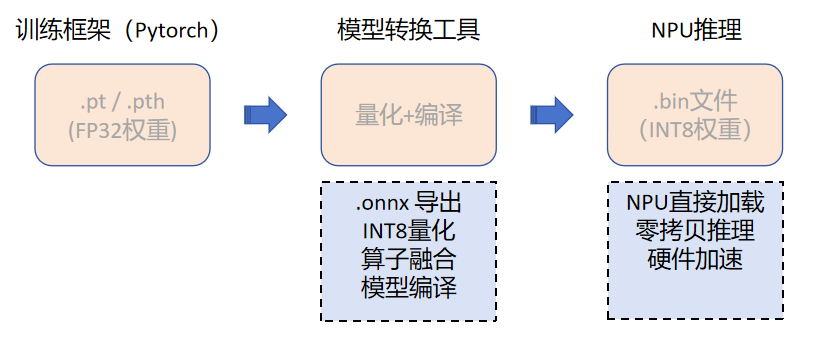
¶ 7.2 Model Conversion Flow
Important:
.binfiles are quantized and compiled for the NPU. You cannot run inference directly with a raw.ptor.onnxfile.
¶ 8 Multi-Model Cascade Example
Face recognition is used here to show how cascading works:
// face recognition needs a 3-model cascade
xmedia_svp_modules modules[3];

// model 1: face detection (locate faces)
modules[0].alg_type  = XMEDIA_SVP_ALG_TYPE_FACE;
modules[0].load_mode = XMEDIA_SVP_MODEL_FILE;
modules[0].format    = XMEDIA_SVP_INPUTDATA_FORMAT_RGB888;
modules[0].pathname  = "./model/gnn_face_detect_640x360_rgb888hwc_v0103_20251209.bin";

// model 2: face landmarks (locate 5 facial points)
modules[1].load_mode = XMEDIA_SVP_MODEL_FILE;
modules[1].format    = XMEDIA_SVP_INPUTDATA_FORMAT_RGB888;
modules[1].pathname  = "./model/gnn_face_keypoint_48x48_rgb888hwc_v0101_20250818.bin";

// model 3: face feature extraction (512-d vector)
modules[2].load_mode = XMEDIA_SVP_MODEL_FILE;
modules[2].format    = XMEDIA_SVP_INPUTDATA_FORMAT_RGB888;
modules[2].pathname  = "./model/gnn_face_recognition_112x112_rgb888hwc_v0101_20250818.bin";

task_cfg.module_num = 3;
task_cfg.task_type  = XMEDIA_SVP_TASK_FACE_RECOGNITON;
task_cfg.modules    = modules;

// create the task
xmedia_svp_task_create(&handle, task_cfg);
The inference call is the same; the SDK handles the cascade internally:
// the inference call is identical to the single-model case
xmedia_svp_fr_output fr_output = {0};
ret = xmedia_svp_task_process(handle, &task_input, &fr_output);

// fr_output.face_num     -> number of detected faces
// fr_output.fr_result[i] -> 512-d feature vector + box per face
¶ 9 Memory Management Strategy
¶ 9.1 Memory Reuse Modes
The SDK supports three memory reuse modes to save memory:
typedef enum {
    XMEDIA_SVP_MEM_TYPE_BLOCK,       // block reuse (recommended)
    XMEDIA_SVP_MEM_TYPE_AINR_SHARE,  // shared with AINR
    XMEDIA_SVP_MEM_TYPE_COMPLETE,    // fully independent
} xmedia_svp_mem_reuse_type;
¶ 9.2 Lifecycle Management
Application start
  │
    +-- xmedia_svp_init()                   // initialize SVP
    +-- xmedia_cl_graph_query_model_info()  // query memory requirements
    +-- MMZ alloc (work/input/output)       // allocate physically contiguous memory
    +-- xmedia_svp_set_config()             // configure memory
    +-- xmedia_svp_task_create()            // create task (load model)
  │
    |   +-- while loop ---------------- +
    |   |  acquire_frame -> task_process  |  // inference loop
  │   │  → draw → venc → release_frame │
  │   └────────────────────────────────┘
  │
    +-- xmedia_svp_task_destroy()           // destroy task (unload model)
    +-- MMZ free (work/input/output)        // free memory
    +-- xmedia_svp_uninit()                 // de-initialize SVP
¶ 9.3 MMZ Memory Operations
// allocate physically contiguous memory
xmedia_u64 phy_addr = xmedia_mmz_alloc("mmz_name", "buf_name", size);

// map into the user-space virtual address space
void *virt_addr = xmedia_mmz_map(phy_addr, size, cache_enabled);

// access the memory (read/write)
memcpy(virt_addr, src, size);

// unmap
xmedia_mmz_unmap(virt_addr);

// free the physical memory
xmedia_mmz_free(phy_addr);
¶ 10 Troubleshooting
¶ 10.1 Inference Failures
| Symptom | Likely cause | Fix |
|---|---|---|
xmedia_svp_task_process returns non-zero |
Model file damaged or missing | Check the .bin path and permissions |
| Intermittent inference failures | Frame acquisition timed out | Increase the milli_sec timeout |
| Memory allocation fails | Not enough MMZ space | Check the mmz configuration and shrink buffers |
| Zero targets detected | Confidence threshold too high | Lower detect_threshold |
¶ 10.2 Performance Tuning
// enable timing statistics (define SAMPLE_TIME_DEBUG at build time)
#define SAMPLE_TIME_DEBUG 1

// print inference time
TIME_COST_START();
xmedia_svp_task_process(handle, &input, &result);
TIME_COST_END();
TIME_COST_PRINT("svp process all");
// sample output: svp process all cost time: 25000 us
¶ 10.3 Offline Testing with a YUV File
When no camera is available, a YUV file can be used as input for offline testing:
// define READ_YUV at build time
#define READ_YUV

// the inference thread reads .yuv files from ./yuv_dir/ automatically
// the file resolution must match the model input (for example 640x360 YUV420SP)
¶ 10.4 OSD Text Overlay
Define the USE_OSD macro at build time and link the canvas and canvas_font libraries:
#ifdef USE_OSD
xmedia_char text[64];
snprintf(text, sizeof(text), "id[%d] score[%.2f]", id, score);
sample_target_osd(&video_frame, x, y, text);
#endif
¶ 11 API Quick Reference
¶ 11.1 SVP Lifecycle APIs
| API | Function | When to call |
|---|---|---|
xmedia_svp_init() |
Initialize the SVP subsystem | Once at application start |
xmedia_svp_uninit() |
De-initialize SVP | At application exit |
xmedia_svp_set_config() |
Set SVP memory configuration | Before creating a task |
xmedia_svp_get_config() |
Get SVP memory configuration | Before allocating memory |
xmedia_svp_task_create() |
Create an inference task | When loading the model |
xmedia_svp_task_destroy() |
Destroy an inference task | When unloading the model |
xmedia_svp_task_set_attr() |
Set task attributes | Any time after creation |
xmedia_svp_task_get_attr() |
Get task attributes | Any time |
xmedia_svp_task_process() |
Run inference | In a loop |
xmedia_svp_get_version() |
Get the SVP version | Any time |
¶ 11.2 Frame Management APIs
| API | Function |
|---|---|
xmedia_vpss_acquire_ochn_frame() |
Acquire a frame from VPSS (blocking) |
xmedia_vpss_release_ochn_frame() |
Release a frame back to the pool |
xmedia_venc_send_frame() |
Send a frame to the encoder |
¶ 11.3 Drawing APIs
| API | Function |
|---|---|
xmedia_vgs_init() |
Initialize VGS |
xmedia_vgs_create_job() |
Create a VGS job |
xmedia_vgs_add_task_cover() |
Add a rectangle-drawing task |
xmedia_vgs_add_task_line() |
Add a line-drawing task |
xmedia_vgs_add_task_osd() |
Add an OSD overlay task |
xmedia_vgs_add_task_scale() |
Add a scaling task |
xmedia_vgs_submit_job() |
Submit the VGS job |
xmedia_vgs_wait_job() |
Wait for the VGS job to finish |
xmedia_vgs_cancel_job() |
Cancel the VGS job |
¶ 11.4 Memory Management APIs
| API | Function |
|---|---|
xmedia_mmz_alloc() |
Allocate physically contiguous memory |
xmedia_mmz_map() |
Map to a virtual address |
xmedia_mmz_unmap() |
Unmap the virtual address |
xmedia_mmz_free() |
Free the physical memory |
¶ Appendix: Key Source Files
| File | Description |
|---|---|
source/gmp/include/xmedia_svp.h |
SVP API definitions (all structures and function declarations) |
sample/npu/demo_ai/sample_svp_main.c |
Complete SVP video development sample (main flow) |
sample/npu/demo_ai/sample_svp_main.h |
Sample header (type definitions) |
source/gmp/usr/svp/src/post_process/yolov5.c |
YOLOv5 post-processing |
source/gmp/usr/svp/src/post_process/yolov5.h |
YOLOv5 post-processing header |
sample/npu/demo_ai/model/ |
Model file directory |
source/gmp/include/xmedia_mmz.h |
MMZ memory management API |
source/gmp/include/xmedia_vgs.h |
VGS graphics drawing API |