¶ 01 GPIO Control
¶ 1. The GPIO Subsystem
In Linux, GPIOs are managed by a dedicated GPIO subsystem built on the kernel's GPIO framework (gpiolib), which provides a standardized abstraction over GPIO hardware. The framework wraps the GPIO controllers of different platforms in a uniform way, so user space or kernel drivers can access GPIO resources consistently. There are two ways to control GPIOs:
- Export them to user space through the sysfs filesystem and then operate on them by reading and writing files. (The legacy GPIO interface, under
/sys/class/gpio/; the Linux kernel no longer recommends it.) - Use the character-device GPIO interface (gpiochip). (The modern GPIO interface, under
/dev/gpiochipN; the officially recommended approach.)
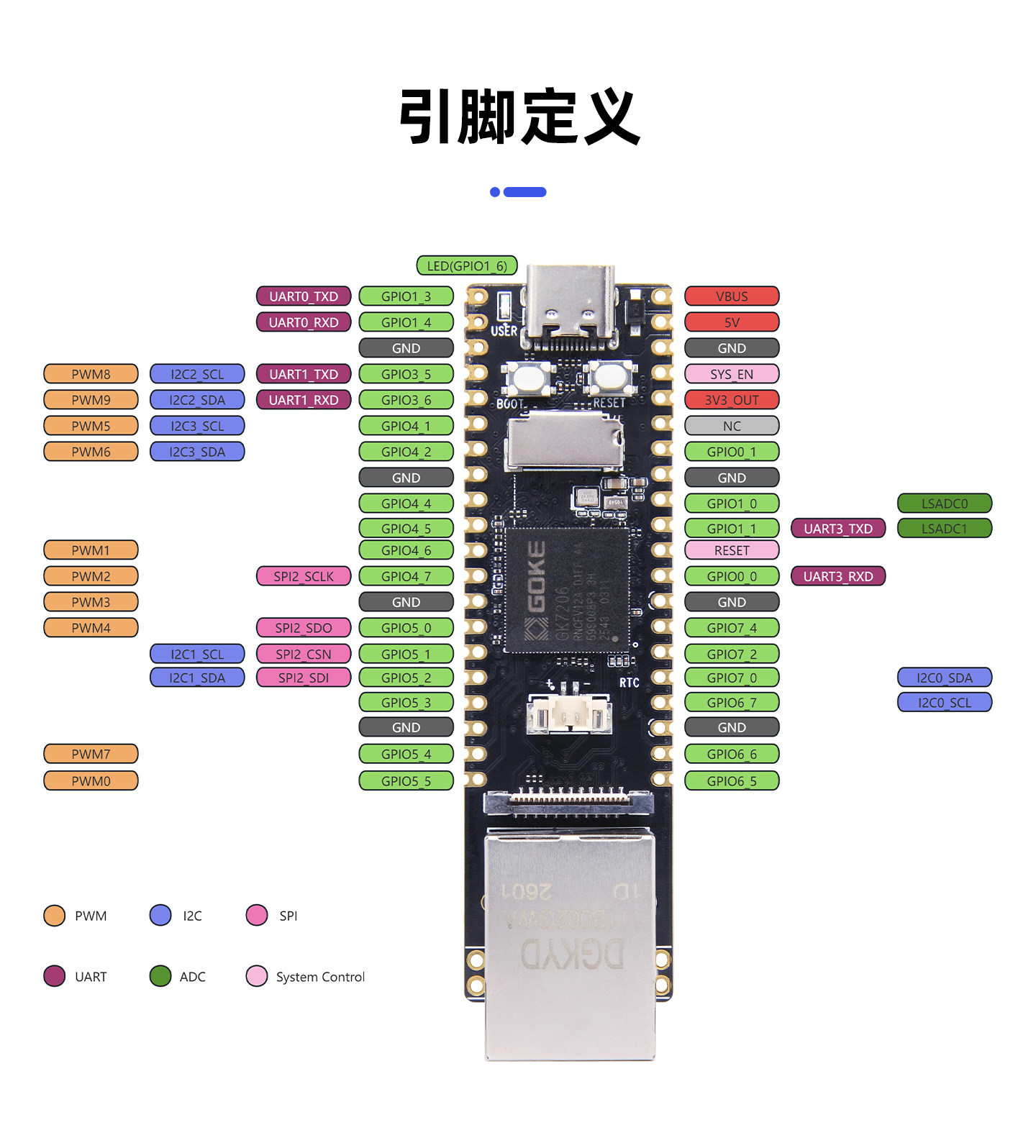
Calculating GPIO numbers
Each GPIO group has 8 pins, and the GPIO number equals
group * 8 + offset within the group. For example GPIO4_2 has GPIO number4*8+2=34. When using the character device driver, forGPIO1_4thechip_pathis/dev/gpiochip1andline_offsetis4.
¶ 2. Character GPIO
¶ 2.1 Terminology
- libgpiod — the standard library for accessing GPIO from Linux user space. It is the official user-space interface to the modern GPIO subsystem (the gpiolib character device interface).
- ioctl — a device control system call used, beyond read/write, to interact with a device driver through command codes (requests) and structured arguments, covering device configuration, status queries, and special controls.
Note
libgpiod is the GPIO user-space reference library provided by Linux. It wraps the GPIO character device ioctl interface and offers a unified API for requesting, controlling, and handling events on GPIO lines. Functionally it is a user-space abstraction layer over GPIO, but underneath it still relies on ioctl to talk to the kernel gpiolib.
That said, you can bypass libgpiod entirely and build your own GPIO abstraction directly on ioctl.
¶ 2.2 Using GPIO ioctl
¶ 2.2.1 Header
linux/gpio.h
This header defines the common structures and ioctls:
- struct gpiohandle_request
- struct gpiohandle_data
- struct gpioevent_request
and these ioctl commands:
- GPIO_GET_CHIPINFO_IOCTL
- GPIO_GET_LINEINFO_IOCTL
- GPIO_GET_LINEHANDLE_IOCTL
- GPIO_GET_LINEEVENT_IOCTL
- GPIOHANDLE_GET_LINE_VALUES_IOCTL
- GPIOHANDLE_SET_LINE_VALUES_IOCTL
¶ 2.2.2 Related Structures
gpiohandle_request
Requests ordinary input/output GPIO lines.
Key members:
- lineoffsets[]: line numbers
- flags: input or output
- default_values[]: default output values
- consumer_label: the owner name shown to the kernel
- fd: returns the line handle on success
gpiohandle_data
Reads and writes line levels.
Key members:
- values[]: the value of each line
gpioevent_request
Requests an interrupt event line.
Key members:
- lineoffset: line number
- handleflags: usually input
- eventflags: rising / falling / both edges
- fd: returns the event fd on success
¶ 2.3 Writing a Breathing-LED Application
See Quick Start / Deploying Your First Application.
¶ Creating gpio_hal.c
#include "gpio_hal.h"

#include <errno.h>
#include <fcntl.h>
#include <stdio.h>
#include <string.h>
#include <sys/ioctl.h>
#include <unistd.h>

int gpio_handle_init(gpio_handle_t *gpio_handle)
{
    struct gpiohandle_request req;

    if (gpio_handle == NULL || gpio_handle->chip_path == NULL) {
        errno = EINVAL;
        return -1;
    }

    gpio_handle->chip_fd = -1;
    gpio_handle->line_fd = -1;

    gpio_handle->chip_fd = open(gpio_handle->chip_path, O_RDONLY);
    if (gpio_handle->chip_fd < 0) {
        perror("open gpiochip");
        return -1;
    }

    memset(&req, 0, sizeof(req));
    req.lineoffsets[0] = gpio_handle->line_offset;
    req.flags = gpio_handle->gpio_mode;
    req.default_values[0] = gpio_handle->default_value ? 1 : 0;
    req.lines = 1;

    if (gpio_handle->consumer_label[0] != '\0') {
        strncpy(req.consumer_label,
            gpio_handle->consumer_label,
            sizeof(req.consumer_label) - 1);
        req.consumer_label[sizeof(req.consumer_label) - 1] = '\0';
    } else {
        strncpy(req.consumer_label, "gpio-led", sizeof(req.consumer_label) - 1);
        req.consumer_label[sizeof(req.consumer_label) - 1] = '\0';
    }

    if (ioctl(gpio_handle->chip_fd, GPIO_GET_LINEHANDLE_IOCTL, &req) < 0) {
        perror("GPIO_GET_LINEHANDLE_IOCTL");
        close(gpio_handle->chip_fd);
        gpio_handle->chip_fd = -1;
        return -1;
    }

    gpio_handle->line_fd = req.fd;
    return 0;
}

int gpio_set_value(gpio_handle_t *gpio_handle, int value)
{
    struct gpiohandle_data data;

    if (gpio_handle == NULL || gpio_handle->line_fd < 0) {
        errno = EINVAL;
        return -1;
    }

    memset(&data, 0, sizeof(data));
    data.values[0] = value ? 1 : 0;

    if (ioctl(gpio_handle->line_fd, GPIOHANDLE_SET_LINE_VALUES_IOCTL, &data) < 0) {
        perror("GPIOHANDLE_SET_LINE_VALUES_IOCTL");
        return -1;
    }

    return 0;
}

void gpio_handle_close(gpio_handle_t *gpio_handle)
{
    if (gpio_handle == NULL)
        return;

    if (gpio_handle->line_fd >= 0) {
        close(gpio_handle->line_fd);
        gpio_handle->line_fd = -1;
    }

    if (gpio_handle->chip_fd >= 0) {
        close(gpio_handle->chip_fd);
        gpio_handle->chip_fd = -1;
    }
}
¶ Creating gpio_hal.h
#ifndef GPIO_HAL_H
#define GPIO_HAL_H

#ifdef __cplusplus
extern "C" {
#endif

#include <linux/gpio.h>

#define GPIO_CONSUMER_LABEL_LEN 32

typedef struct gpio_handle_t {
    int chip_fd;
    const char *chip_path;
    unsigned int line_offset;
    unsigned int gpio_mode;
    int default_value;
    int line_fd;
    char consumer_label[GPIO_CONSUMER_LABEL_LEN];
} gpio_handle_t;

int gpio_handle_init(gpio_handle_t *gpio_handle);
int gpio_set_value(gpio_handle_t *gpio_handle, int value);
void gpio_handle_close(gpio_handle_t *gpio_handle);

#ifdef __cplusplus
}
#endif

#endif
¶ Creating main.c
#include "gpio_hal.h"

#include <linux/gpio.h>
#include <stdio.h>
#include <string.h>
#include <unistd.h>

#define LED_CHIP_PATH "/dev/gpiochip1"
#define LED_LINE      6

int main(void)
{
    gpio_handle_t led_handle;

    memset(&led_handle, 0, sizeof(led_handle));
    led_handle.chip_path = LED_CHIP_PATH;
    led_handle.line_offset = LED_LINE;
    led_handle.gpio_mode = GPIOHANDLE_REQUEST_OUTPUT;
    led_handle.default_value = 0;
    snprintf(led_handle.consumer_label, sizeof(led_handle.consumer_label), "led-gpio");

    if (gpio_handle_init(&led_handle) < 0) {
        perror("gpio_handle_init");
        return 1;
    }

    printf("LED GPIO set high\n");
    if (gpio_set_value(&led_handle, 1) < 0) {
        gpio_handle_close(&led_handle);
        return 1;
    }

    sleep(5);

    printf("LED GPIO set low\n");
    if (gpio_set_value(&led_handle, 0) < 0) {
        gpio_handle_close(&led_handle);
        return 1;
    }

    gpio_handle_close(&led_handle);
    return 0;
}
¶ Creating the Makefile
SDK_DIR := $(shell cd $(shell pwd)/../../.. && /bin/pwd)

include $(SDK_DIR)/build/base.mk

TARGET := gpio

SRCS := main.c gpio_hal.c

OBJS := $(SRCS:.c=.o)

.PHONY: all clean install

all: $(TARGET)

$(TARGET): $(OBJS)
    $(CC) $(SDK_LD_CFLAGS) -o $@ $^

%.o: %.c
    $(CC) $(SDK_USR_CFLAGS) -c -o $@ $<

install: all
    @mkdir -p $(XMEDIA_ROOTFS_DIR)/usr/bin
    @cp -f $(TARGET) $(XMEDIA_ROOTFS_DIR)/usr/bin/$(TARGET)
    @chmod 755 $(XMEDIA_ROOTFS_DIR)/usr/bin/$(TARGET)
    @echo "Installed $(TARGET) to $(XMEDIA_ROOTFS_DIR)/usr/bin/$(TARGET)"

clean:
    rm -f $(TARGET) $(OBJS)
¶ Building into the rootfs, logging in to Pico-G1, and running the application
¶ Expected result: the LED lights up for 5 seconds and then turns off
Important
If the result does not match, the GPIO driving the LED may be multiplexed to another function. Run:
xmmd.l 0x11980018 # read the value of the GPIO1_6 register xmmm 0x11980018 0x00001000 # write the registerThen run the application again.
¶ 3. Controlling GPIO with sysfs
¶ 3.1 Exporting a GPIO to User Space
Under /sys/class/gpio, each GPIO has its own folder, named gpio plus the pin number. For example /sys/class/gpio/gpio14 is pin number 14, i.e. GPIO1_6. To check:
~ # echo 14 > /sys/class/gpio/export
~ # ls /sys/class/gpio/
export      gpiochip0   gpiochip24  gpiochip40  gpiochip56  gpiochip8
gpio14      gpiochip16  gpiochip32  gpiochip48  gpiochip64  unexport
Note
echo 14 > /sys/class/gpio/exportexports GPIO14 to user space, which creates/sys/class/gpio/gpio14. Useecho 14 > /sys/class/gpio/unexportto undo the export.
¶ 3.2 The GPIO Control Directory
The exported GPIO's control directory (/sys/class/gpio/gpio14) usually contains these files:
~ # ls /sys/class/gpio/gpio14/
active_low  direction   power       uevent
device      edge        subsystem   value
¶ active_low
Inverts the GPIO level logic:
echo 1 > /sys/class/gpio/gpio14/active_low # invert the logic level of GPIO14
¶ direction
Sets the GPIO direction, input or output:
echo in > /sys/class/gpio/gpio14/direction	# input
echo out > /sys/class/gpio/gpio14/direction	# output
¶ power
Power-management related; normally not manipulated directly.
¶ uevent
Related to device events; not usually needed for everyday manual GPIO control.
¶ device
Information about the device this GPIO belongs to.
¶ edge
echo both > /sys/class/gpio/gpio14/edge
Configures interrupt trigger edges. Common values:
- none: no interrupt
- rising: trigger on rising edge
- falling: trigger on falling edge
- both: trigger on both edges
¶ subsystem
Which subsystem this GPIO belongs to.
¶ value
Reads or sets the GPIO level:
cat /sys/class/gpio/gpio14/value # read the level
echo 1 > /sys/class/gpio/gpio14/value	# drive high
echo 0 > /sys/class/gpio/gpio14/value	# drive low